

Ndabeni Takes Spaza Shop Support to Eshowe: Stock Handover Kicks Off Rural Retail Revival
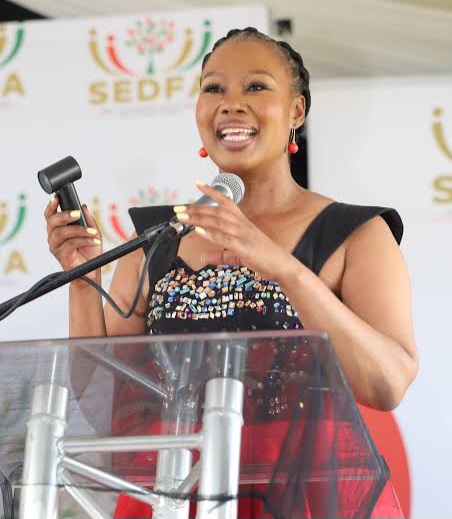 Photo: Minister of Small Business Development, Stella Tembisa Ndabeni.
Small Business Development Minister Stella Tembisa Ndabeni handed over stock to spaza shop owners in Oyaya, outside Eshowe, as part of a broader push to channel government funding into rural and township retail enterprises.
Facilitated by the department’s agency, the Small Enterprise Development and Finance Agency (Sedfa), formed part of the ministerial outreach programme aimed at taking government support directly to small, micro, and medium enterprises operating in rural communities.
The handover falls under the R500 million Spaza Shop Support Fund, launched in 2025 to increase the participation of South African-owned spaza shops in the township and rural retail trade sector. The fund offers support of up to R100 000 per shop, through a combination of grants and low-interest loans, covering initial stock, infrastructure improvements, point-of-sale systems, and compliance assistance.
The event formed part of a second leg of the ministerial outreach in the King Cetshwayo District, where Ndabeni met Inkosi Siyaya Ntuli of the Ntuli Traditional Council and local entrepreneurs, where Ndabeni stressed that rural entrepreneurs should not be disadvantaged simply because they operate outside major economic centres.
Speaking at the handoverceremony, Ndabeni stressed that rural business owners should not be disadvantaged by their distance from major economic centres. “Our responsibility is not only to make funding available, but also to ensure that entrepreneurs understand the programmes and know how to access them,” she said. “We want our programmes to have a practical impact on businesses and communities, rather than remain programmes that entrepreneurs only hear about from a distance, ” Ndabeni said during here address.
Sedfa acting CEO Nkosikhona Mbatha reaffirmed the agency’s commitment to ensuring that qualifying South African-owned spaza shops benefit, while noting that verification measures were necessary to protect the fund against fraud and fronting. “We want to see more applications coming through so that we are able to utilise the entire fund we have,” Mbatha said.
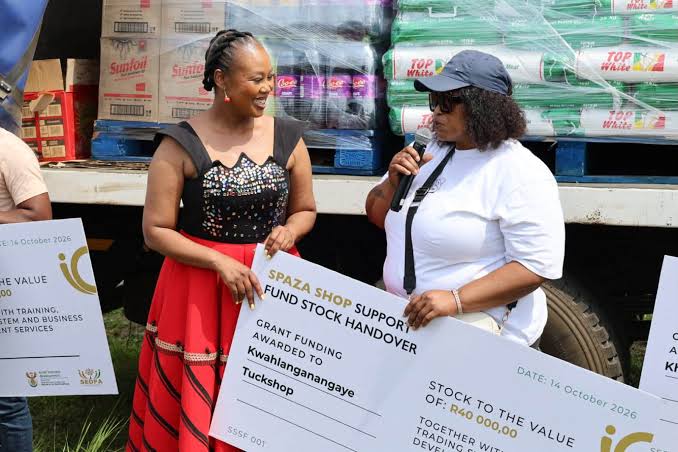 Photo: Minister Stella Ndabeni with Ayanda Myeza, one of the beneficiaries who received stock.
Inkosi Siyaya Ntuli called for practical solutions that would allow local entrepreneurs to legally own and operate spaza shops while meeting the requirements, urging stronger collaboration between traditional councils, municipalities, and the department.
Inkosi Ntuli further highlighted that such direct engagement allowed the government to better understand the obstacles faced by small businesses in rural areas, adding that the programme reinforced government’s commitment to fostering rural entrepreneurship and sustainable local economic development.
One of the beneficiaries of this fund, Ayanda Myeza of Kwahlangana Ngawe Tuckshop located in Emasundwini Reserve, sang high praises for the support received. “I want to thank th Minister for the support given to us today and our local leadership for linking us up with the department. This will make a huge difference in our lives and we have never been assisted this way in our area, it is for the very first time. Stock has always been a problem as we could not stock up everything needed due to financial challenges, and this will assist us a long way in sustaining our businesses,” said Myeza after receiving stock.
Beyond the spaza fund – other support mechanisms for rural and township enterprises
The Department of Small Business Development (DSBD) offers several additional funding instruments tailored to rural, township, and co-operative enterprises:
· Township and Rural Entrepreneurship Programme (TREP): Supports informal, micro and small enterprises and co-operatives operating in township and rural economies, providing blended finance and business development support. In the 2025/26 financial year, TREP disbursed more than R829 million, supporting 111 000 SMMEs in the township and rural economy. The maximum funding threshold per qualifying enterprise was recently increased from R1 million to R3 million.
· Informal and Micro Enterprise Development Programme (IMEDP): A 100% grant for informal and micro enterprises, ranging from a minimum of R500 up to a maximum of R15 000, for the procurement of tools, equipment, and stock. The programme aims to support 6 000 informal businesses over the medium term.
· Co-operatives Development Support Programme (CDSP): Offers blended financing—combining grants and loans—to eligible co-operatives, with DSBD contributing up to 50% of approved interventions. Funding is available up to a maximum of R1.5 million depending on the category of the co-operative.
· Asset Assist Programme (AAP): Provides machinery, equipment, working capital, and raw materials, with a maximum grant of R250 000.
· Business Infrastructure Support Programme (BISP): Supports MSMEs with business-enabling machinery, equipment, tools, technology, energy support, and infrastructure.
Ndabeni said the department’s priority was to ensure that small-business owners in rural areas were aware of these mechanisms and able to access them. The outreach comes as spaza shops and other informal businesses continue to provide livelihoods and essential services in rural communities across South Africa.
The outreach comes as spaza shops and other informal businesses continue to play a significant role in providing livelihoods and essential services in rural communities across South Africa.
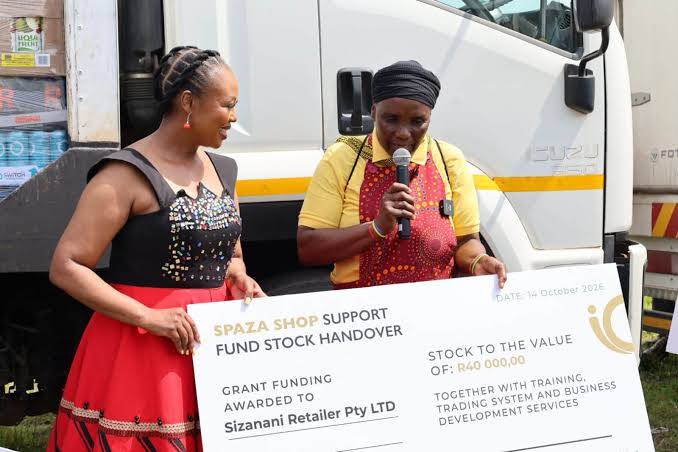 Photo: Minister Ndabeni with another beneficiary.